


"You're gonna need a bigger boat." — Chief Brody, Jaws (1975)
June 25, 2018. A cold email from a founder I had never met, raising his first round for a pre-launch cookware brand. Parfait would become Caraway. Jordan Nathan, twenty-something. The email:
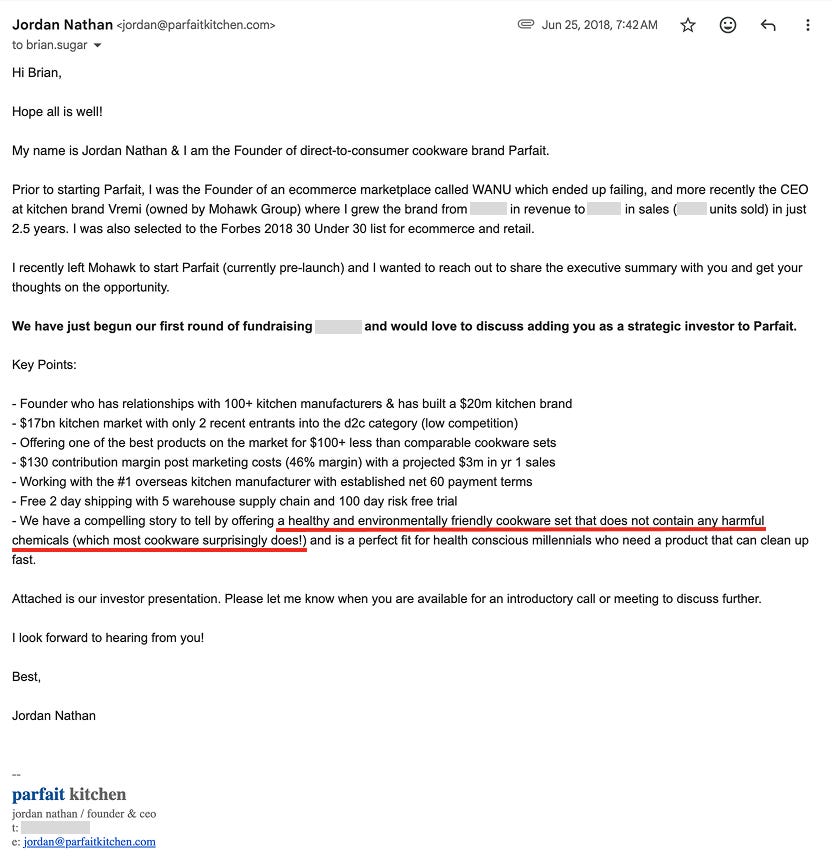
Buried in the bullets, plain as a recipe card: a healthy and environmentally friendly cookware set that does not contain any harmful chemicals (which most cookware surprisingly does!)
Before the brand had a customer or a name worth defending. The thesis was already written down, in a cold email, in a parenthetical.
Seven years later, on February 13, 2026, Groupe SEB and Meyer, the world’s two largest cookware conglomerates, sued Caraway in the Southern District of New York. Two hundred years of history. Ten billion in revenue. Forty thousand employees. Caraway has one hundred. The complaint accuses the brand of building a business on a false premise.
The premise was in the cold email. They are arguing eight years late.
They want an injunction, corrective advertising, disgorgement. In plain language, they want Caraway to shut up.
This is what losing the cultural argument looks like.
For most of consumer history, incumbents had three weapons. Out-spend on shelf. Out-price through scale. Out-distribute through retail. When those levers worked, lawsuits were unnecessary. Unilever didn’t sue Dollar Shave Club. They bought it. P&G didn’t sue Native. They acquired it. The playbook was to write a check and absorb the disruption.
Groupe SEB and Meyer could have bought Caraway. They sued instead. Litigation is what happens when the first three levers have failed.
Eight U.S. states have moved to restrict PFAS in cookware. Thirty more have moved on broader PFAS regulation. The EU is moving the same way. Target, Walmart, Crate & Barrel, Macy’s all carry Caraway. The fight for the consumer’s mind, the only fight that matters, was lost between 2022 and 2025, while Big Cookware was forming a 501(c)(6) to lobby legislators about fluoropolymers. They were arguing science with regulators while Caraway was building trust with parents.
One is a winning strategy.
The other is a brief.
The complaint spends pages parsing whether non-stick pans can be called toxic. It is the document of a company looking for growth in a courtroom instead of a kitchen.
The NAD found Caraway’s PFAS-free and non-toxic claims supported. It asked for some comparative ads pulled. The complaint says some stayed up. That is the legal fight. The cultural fight ended years ago.
This is what desperation in a suit and tie looks like.
Big incumbents reach for litigation when the cultural tide has already turned. The lawsuit isn’t the threat to the challenger. The lawsuit is the eulogy for the incumbent’s pricing power.
Big Cookware spent decades coating American kitchens in chemicals consumers no longer trust, then hired floors of lawyers to argue the chemistry was fine, actually. They funded studies. They hired lobbyists. They did everything except reformulate the pan.
Here is what makes Jordan dangerous. He pulled his investor base into a single email and asked them to fight. He is not fighting a legal problem. He is building a movement. Big Cookware built a lobbying shop. Jordan built a coalition. Lobbyists write memos. Coalitions write history.
On every metric in the old game, Jordan loses. On the metrics that matter in the new one, he is already winning. Independent labs. Six hundred PFAS compounds tested. Reports published openly. Transparency became the offense.
When two incumbents coordinate to sue a single challenger, they are not protecting a market. They are admitting they have already lost it. A militia formed after the war is over.
The conglomerates can keep filing. None of it changes the chemistry on the shelf or the conversation in the home. None of it pulls back the parents who replaced their pans. The information has left the building.
Somewhere tonight, a mother is unboxing a Caraway pan and throwing the old one away. She is not thinking about Groupe SEB or Meyer. She is thinking about her kid, about the pan her own mother used, and her grandmother before that, and the quiet realization that none of them had a choice.
She does.
That is the moment Big Cookware lost. Not in a deposition. Not in a press release. In a kitchen, at night, with a child asleep upstairs.
It happened thousands of times a day while the giants were drafting briefs.
The litigation will play out in court. This essay is not about the legal merits. It is about what the lawsuit reveals: the children in the houses Big Cookware used to own are growing up in kitchens that no longer have their name on the pan.
That is how giants fall. Not in a single blow. In a generation that stops repeating the name.
This is about which generation gets to define what clean means. Whoever earns that word owns the next twenty years of the kitchen, the bathroom, and the pantry.
I signed. Lisa signed. Sugar Capital signed. If you’ve made it this far, you should too.
Big Cookware didn’t sue Caraway because Caraway was wrong.
Big Cookware sued Caraway because Caraway was right.
Go pick on someone your own size.

Disclosures: Sugar Capital is an investor in Caraway.
Well said Brian.